
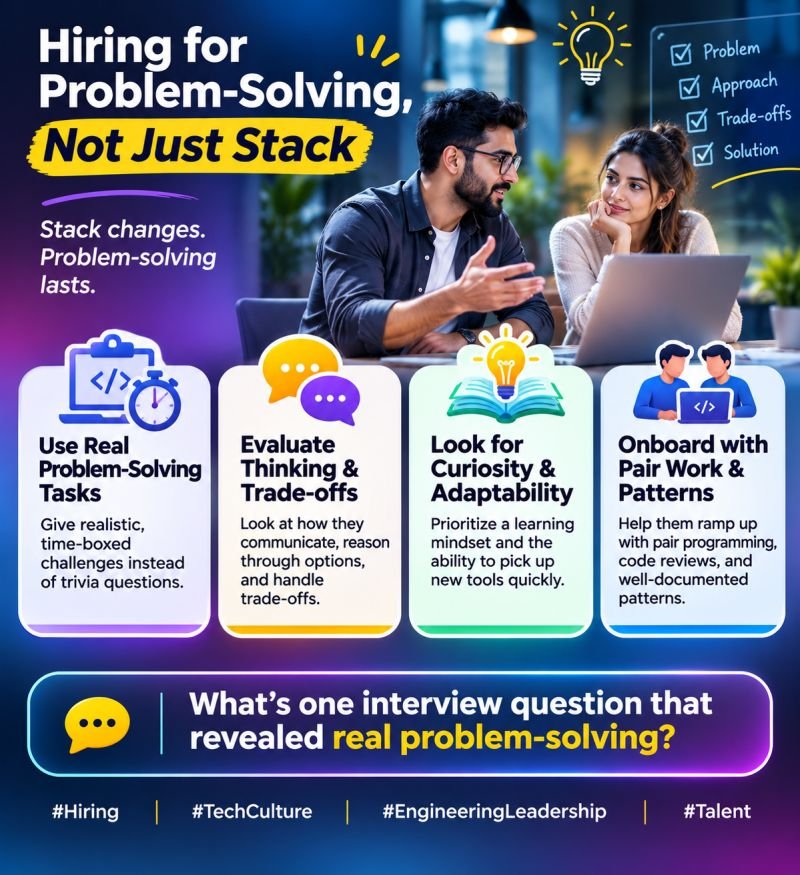
You can teach someone a new tech stack. Teaching them how to think is a different challenge.
Technology changes constantly.
Frameworks evolve, programming languages gain new capabilities, and tools that are popular today may look completely different in a few years.
That’s why hiring purely based on a candidate’s current tech stack can be a costly mistake.
Great engineering teams aren’t built just by hiring people who know the right tools. They’re built by hiring people who know how to solve problems.
Here are four things worth prioritizing when hiring technical talent:
🔹 1. Test real problem-solving, not memorized answers
Instead of relying on trivia questions, use realistic, time-boxed technical tasks.
Give candidates a problem that reflects actual engineering work and see how they approach it.
🔹 2. Evaluate how they think, not just what they deliver
A correct answer doesn’t always tell the whole story.
Pay attention to how candidates explain their decisions, communicate challenges, consider alternatives, and handle trade-offs.
The reasoning behind a solution is often more valuable than the solution itself.
🔹 3. Look for curiosity and adaptability
Today’s developers work with constantly evolving technologies.
Someone who demonstrates curiosity, learns independently, and adapts to unfamiliar tools can bring long-term value to a team.
Don’t underestimate learning ability.
🔹 4. Make onboarding part of your engineering culture
Hiring the right person is only the beginning.
Pair programming, code reviews, technical documentation, and shared coding standards help new team members understand the architecture and become productive faster.
Here’s what I believe:
Skills get someone through the door. Problem-solving, communication, and adaptability help them grow.
The best hiring process shouldn’t just identify who knows the most technologies.
It should identify who can think critically, learn continuously, and contribute to solving real business problems.