
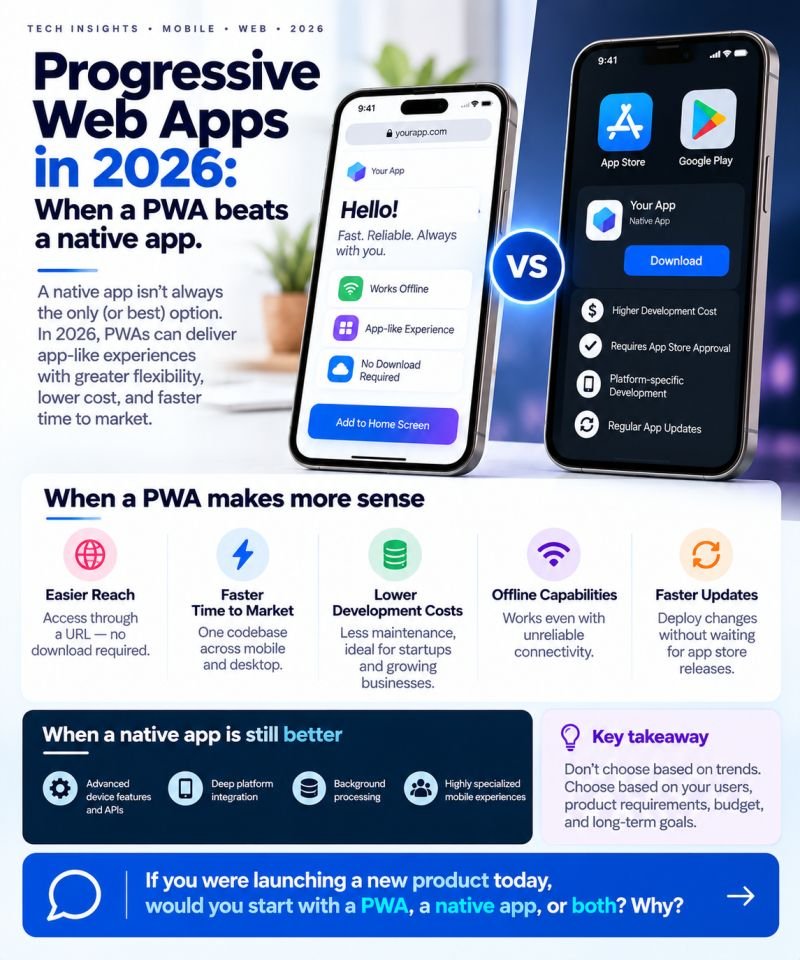
Do you really need a native app in 2026? Sometimes, a PWA is the smarter choice. 🚀
Building a mobile app doesn’t always mean publishing to the App Store or Google Play.
For many businesses, a Progressive Web App (PWA) can deliver an app-like experience directly through the browser—with less development overhead and a simpler path to reaching users.
So, when does a PWA make more sense than a native app?
📱 1. When reach matters more than app store presence
Users can access your PWA through a URL without downloading an app first. That makes it easier to share, discover, and start using.
⚡ 2. When speed to market is important
With a shared web codebase, teams can often deliver features across mobile and desktop without maintaining entirely separate iOS and Android applications.
💰 3. When you need to control development costs
A PWA can reduce duplicated development and maintenance work, especially for startups, internal business tools, content platforms, and eCommerce websites.
🌐 4. When offline access adds value
Service workers and caching can help users access selected content and functionality even with unreliable connectivity—provided the experience is designed for it.
🔄 5. When frequent updates matter
Web-based deployment allows many updates to reach users without requiring a traditional app store release for every change.
But PWAs aren’t the answer to everything.
Native apps may be the better choice when your product depends heavily on advanced device APIs, background processing, platform-specific integrations, or a deeply integrated mobile experience.
Platform support also matters. PWA installation, background capabilities, and push notifications can differ across browsers and operating systems.
My take: Don’t choose between PWA and native based on trends. Choose based on your users, product requirements, budget, and long-term roadmap.
The smartest architecture is the one that solves the problem without adding unnecessary complexity.